Does how you film and edit actually matter?
November 2026
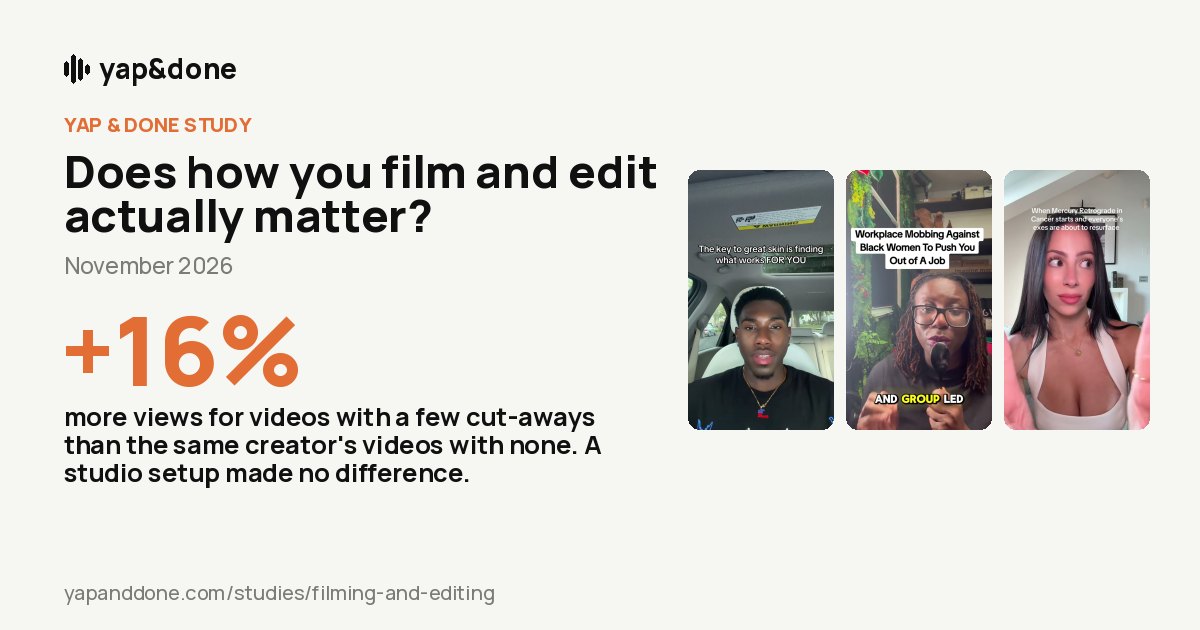
+16%more views for videos with a few cut-aways than the same creator's videos with none. A studio setup made no difference.


Do you need a studio? Does b-roll help? Should you cut fast? We looked at 11,212 TikTok talking-head videos from 923 creators, each against the same creator's other videos.
The top lessons you can use
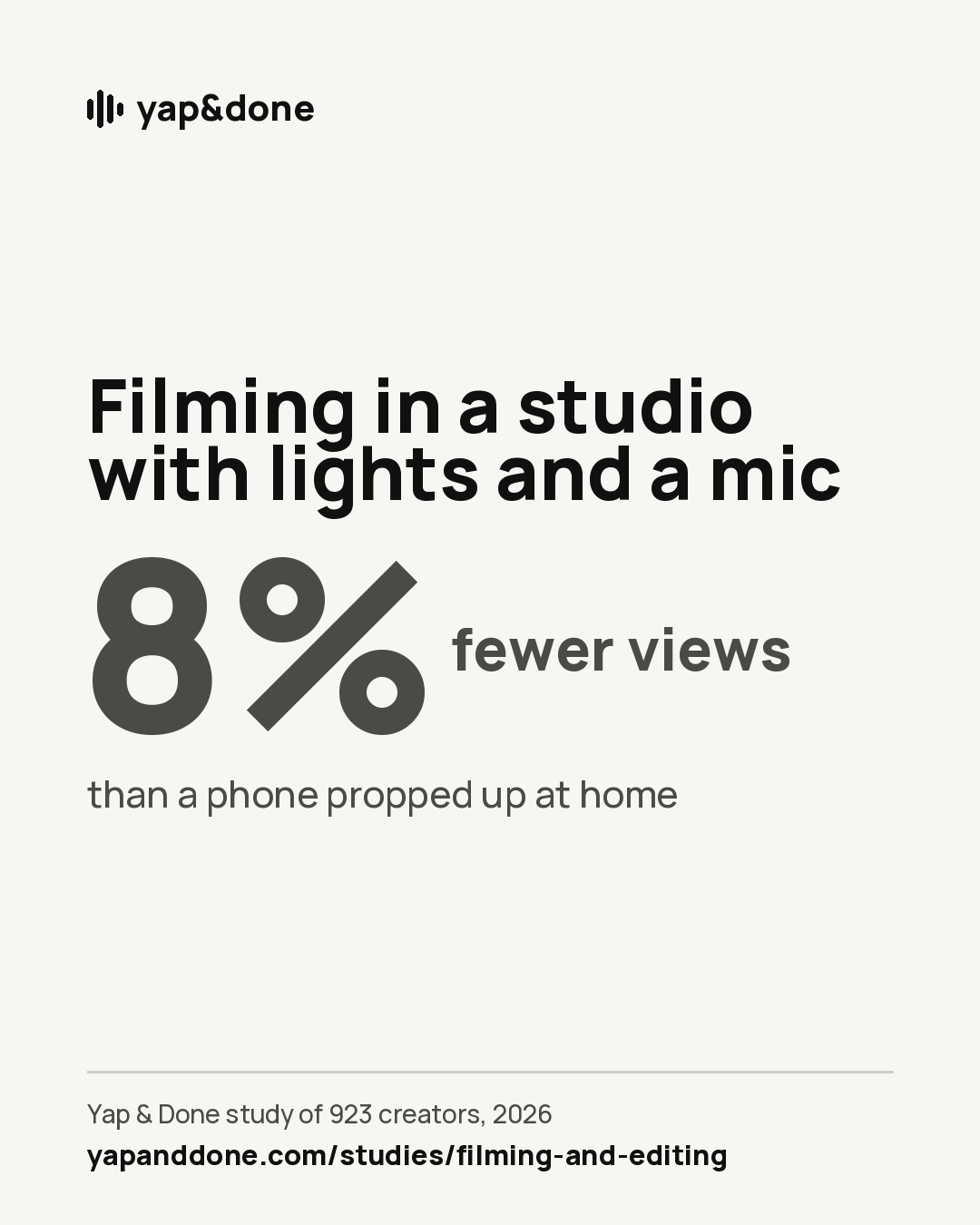
- Skip the studio. A phone propped up in your room did at least as well as a full studio setup with lights and a mic.
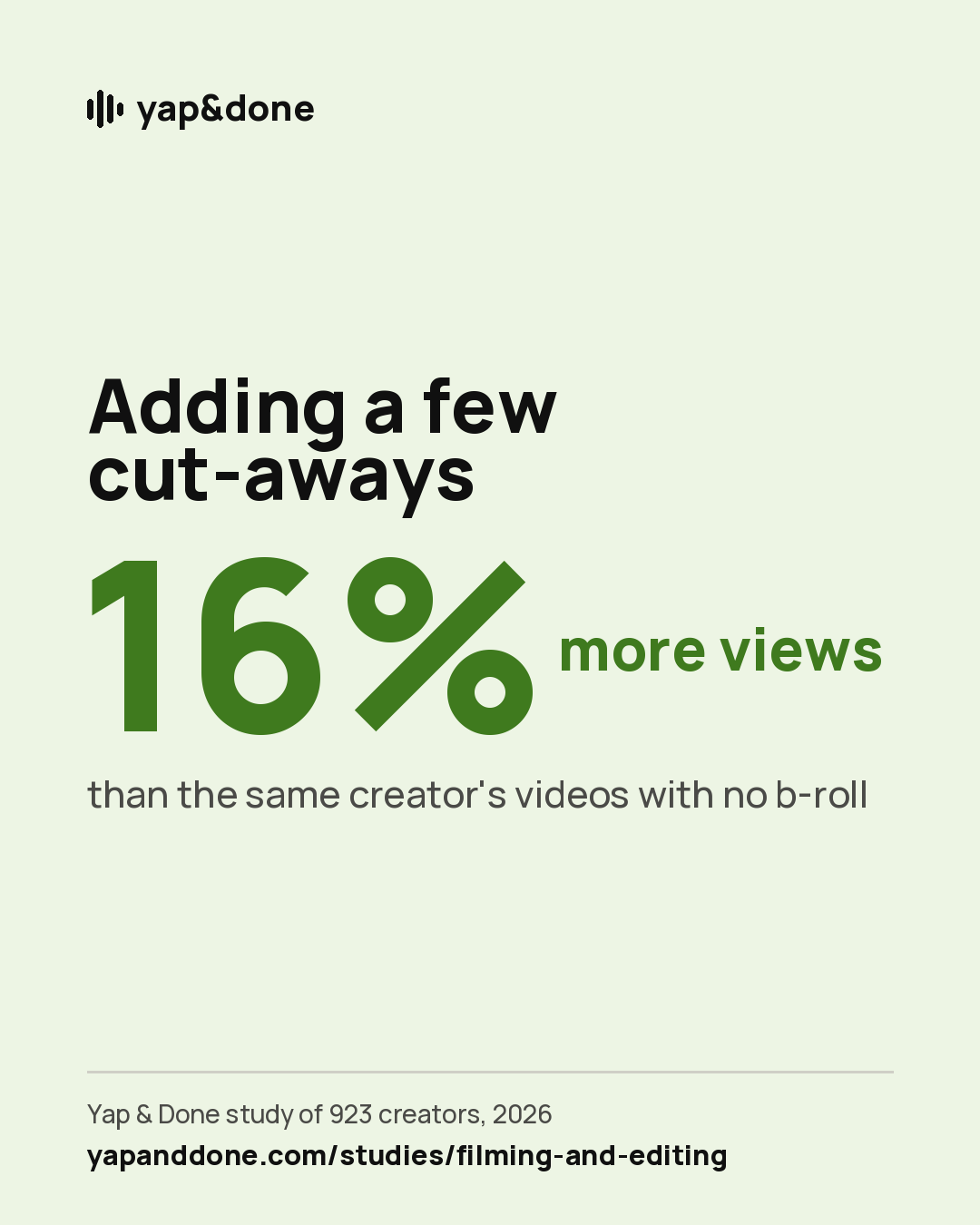
- Add a few cut-aways. Videos with some b-roll got about 16% more views than the same creator's videos with none.
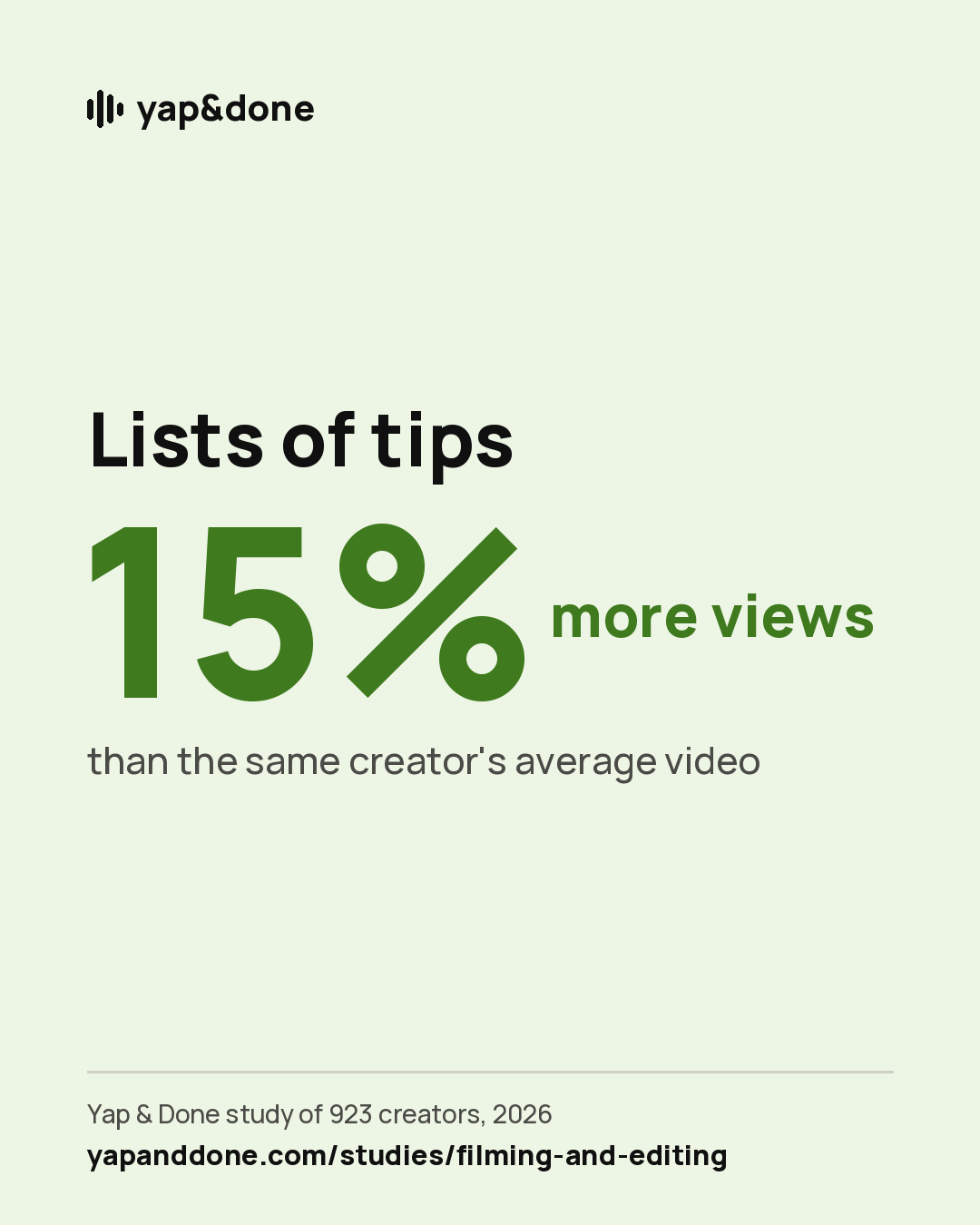
- Teach something. Lists of tips got 15% more views and how-tos 7% more views than the creator's average video, plus about 29% more saves.
- Cut the dead air, but don't overdo it. A few cuts a minute got about 18% more saves than one long take; non-stop cutting lost saves again. Views stayed about the same either way.
- Open mid-sentence, looking into the camera. It didn't change views, but it got about 14% more saves.
- Frame it close. Close-ups got about 10% more views than medium shots.
Key points
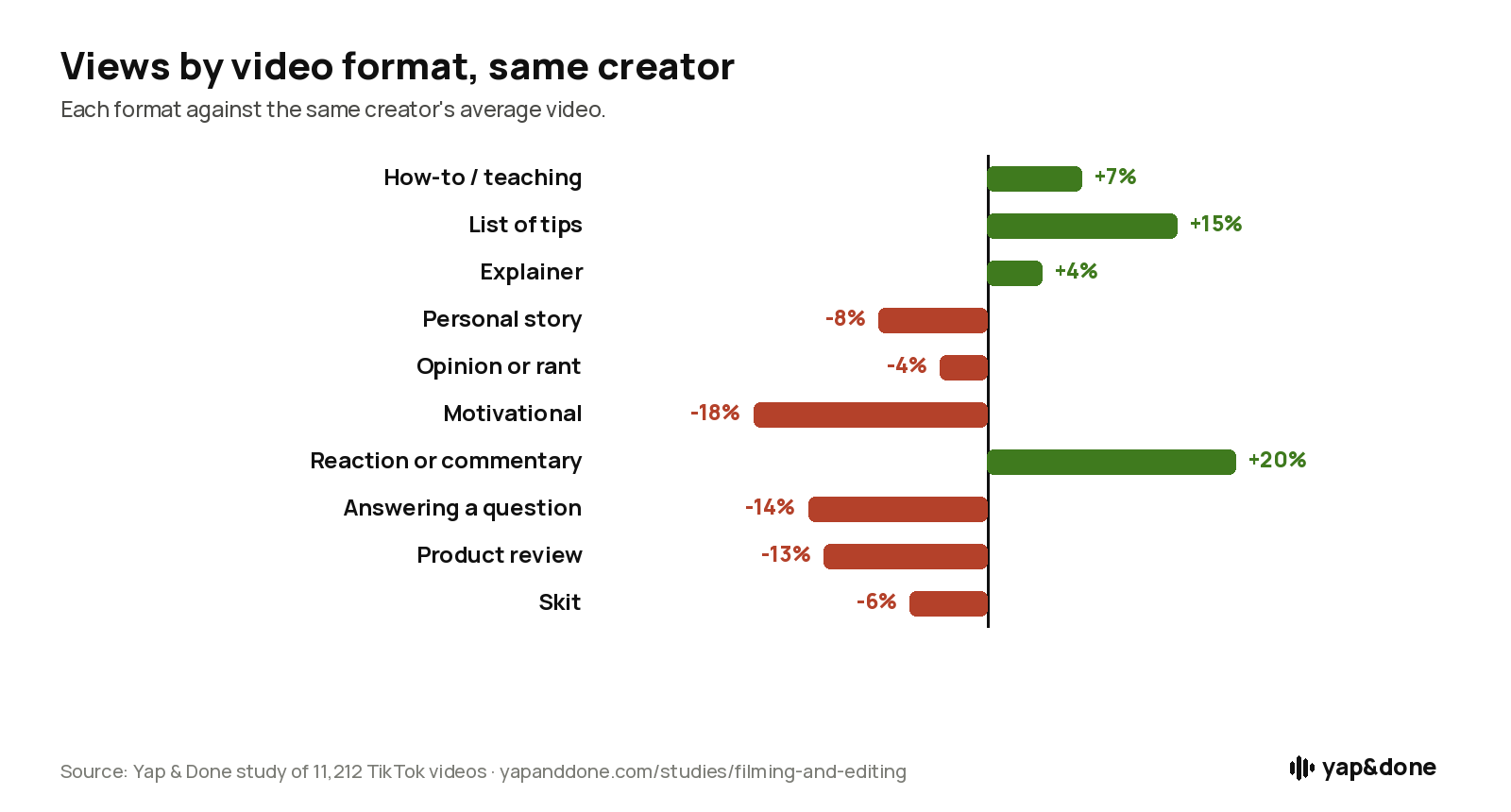
Lists of tips got 15% more views and how-tos 7% more views; motivational videos got 18% fewer views and product reviews 13% fewer views, all against the same creator's average.
Phone in hand, phone propped up, or a studio with lights and a mic: views were within a few percent. 72% of creators film on a propped-up phone.
Videos with some cut-aways got 16% more views and 17% more saves than the same creator's videos with none.
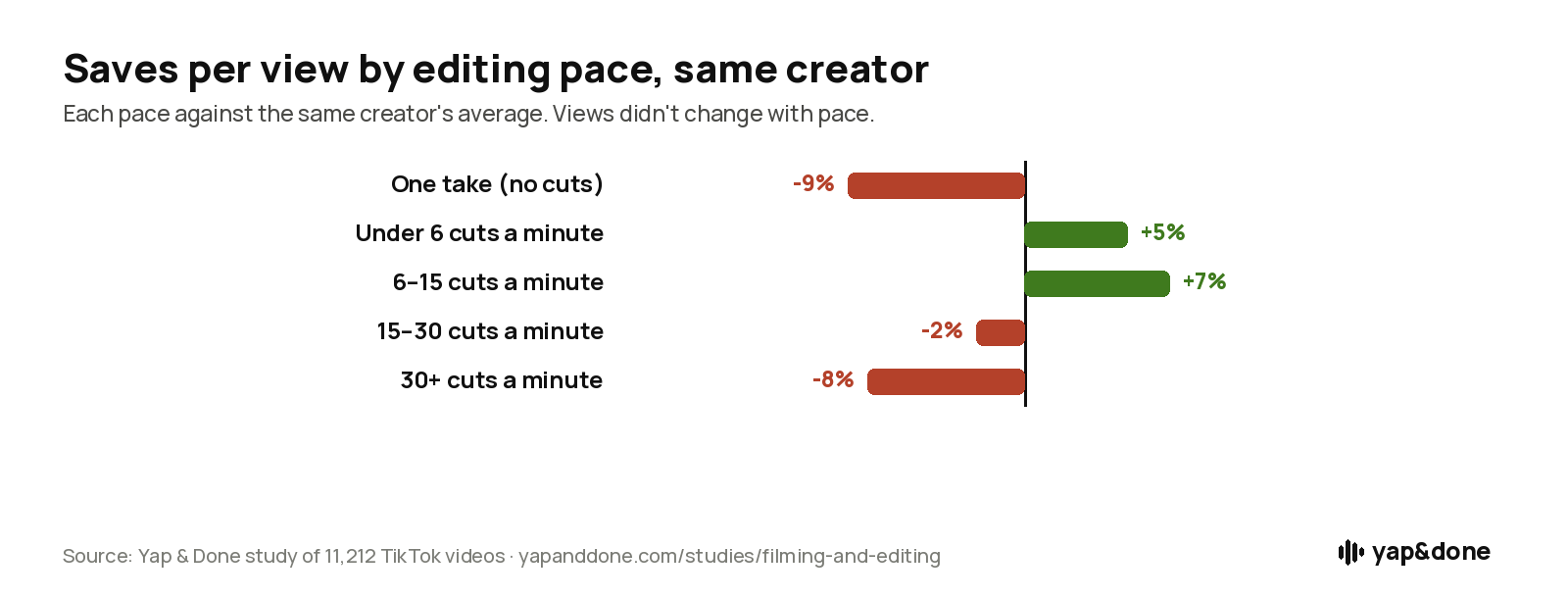
How fast you cut didn't change views, but a few cuts a minute got about 18% more saves than a single take. Cutting every two seconds got 14% fewer saves.
Opening while looking into the camera got about 15% more saves than looking away; opening mid-sentence about 12% more saves and shares than a posed start.
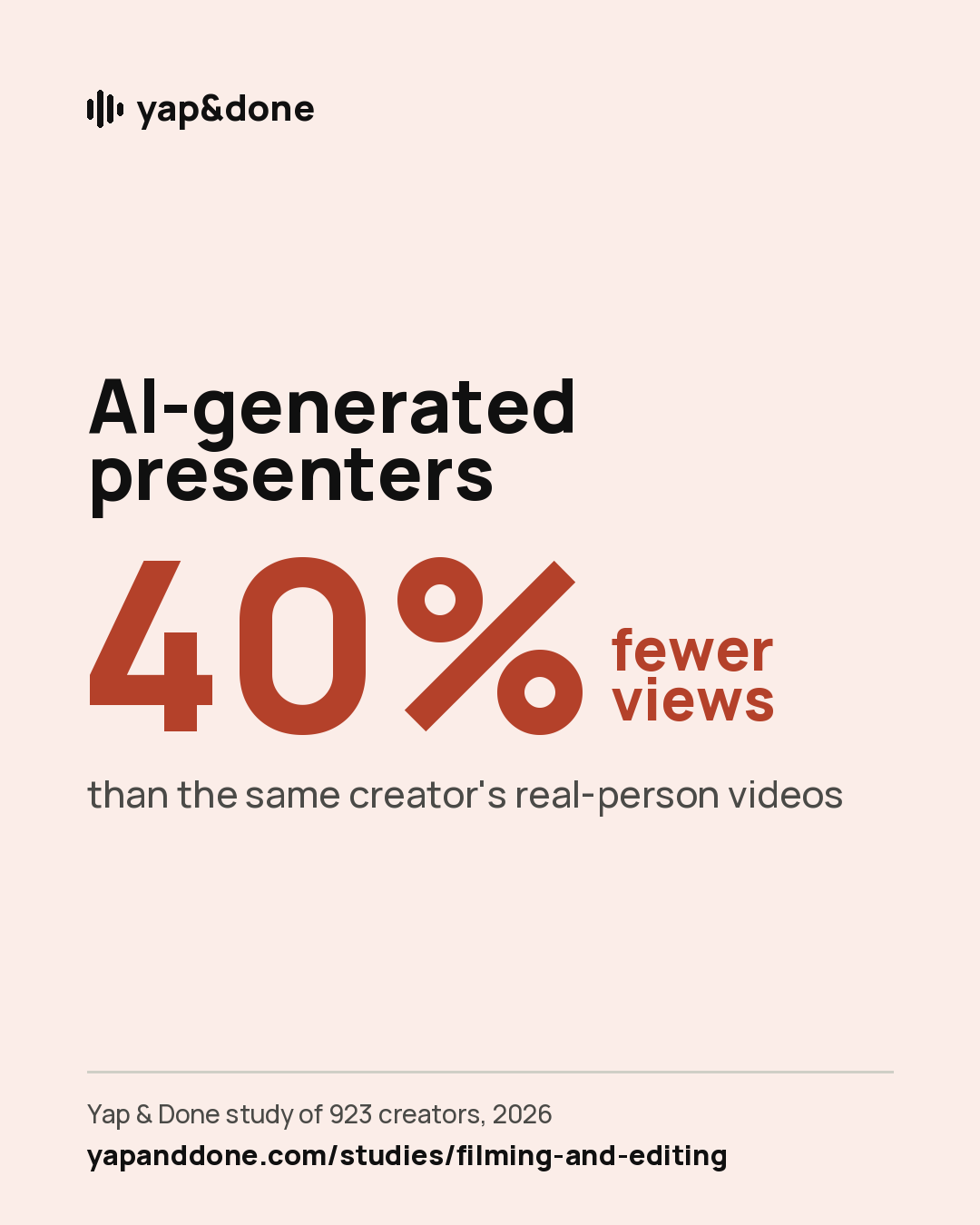
Early sign: videos with an AI-generated presenter got about 40% fewer views than the same creator's videos with a real person (32 creators).
The specifics
What you make matters more than how you film it
Comparing each creator with their own videos, lists of tips got 15% more views and how-to videos 7% more views than the creator's average. Motivational videos got 18% fewer views, answering a viewer's question 14% fewer views and product reviews 13% fewer views. Tips and how-tos also got about 29% more saves, while personal stories got 34% fewer saves.
A studio setup doesn't get you more views
Videos filmed with lights and a mic in a studio did no better than the same creator's videos filmed on a propped-up phone (−8%, within the margin of error). Filming handheld, selfie-style, didn't cost views either, though it got a few percent fewer saves. Setting (car, home, desk, outdoors) made no clear difference.
A few cut-aways help
Videos with some b-roll (screen recordings, photos, clips that cut away from the speaker) got 16% more views and 17% more saves than the same creator's videos with none. Videos that were mostly b-roll didn't do better still. 80% of talking-head videos have no cut-aways at all.
Editing pace changes saves, not views
We counted the cuts in 13,182 videos. The number of cuts made no clear difference to views. But compared with the same creator's single-take videos, videos with a moderate pace (about 6–15 cuts a minute) got about 18% more saves, and very fast editing (30+ cuts a minute) got about 14% fewer saves than a moderate pace. The pattern held however strictly we counted a cut.
The first frame shapes engagement, not reach
Almost every video (97%) opens on a face. Whether the creator was smiling, looking into the camera or caught mid-sentence made no difference to views. It did change what viewers did: looking into the camera got about 15% more saves than looking away, and opening mid-sentence about 12% more saves than a still, posed start.
Close-ups beat medium shots
Videos where the creator's face filled most of the frame got about 10% more views than the same creator's medium shots.
AI-generated presenters: an early warning
About 1.5% of the talking-head videos we checked had an AI-generated presenter. Among the 32 creators who posted both, their AI-presenter videos got about 40% fewer views than their videos with a real person. It's a small group, so treat this as a first signal.
What you make matters more than how you film it
Each type of video against the same creator's average video. Green means more than their usual; red means fewer.
Views
Saves per view
A studio doesn't get you more views
How the video was filmed and where, each against the same creator's average.
Camera setup: views
Camera setup: saves per view
Setting: views
Share of videos: Phone in hand (selfie) 12% · Phone propped up, everyday room 72% · Studio setup (lights, mic) 16%.
A few cut-aways and a close shot help
Cut-aways and b-roll: views
Cut-aways and b-roll: saves per view
Framing: views
80% of talking-head videos have no cut-aways at all.
Cutting changes saves, not views
We downloaded 13,182 videos and counted their cuts. Each pace against the same creator's average.
Views
Saves per view
Shares per view
The same pattern shows however strictly a cut is counted (see Method & details).
Look into the camera, start mid-sentence
None of these changed views. They did change saves and shares. Each against the same creator's average.
Eye contact: saves per view
Motion: saves per view
Expression: shares per view
AI-generated presenters: an early warning
Videos where the on-camera person looks AI-generated, against the same creator's videos with a real person.
Only 1.5% of videos had an AI presenter, so this rests on 32 creators. Treat it as a first signal.
Questions people ask
Do I need a studio, lights or a good mic for TikTok?
Not for views. Studio videos did no better than the same creator's videos filmed on a propped-up phone (the small difference was within the margin of error).
Should I add b-roll to talking-head videos?
Some, yes. Videos with some cut-aways got about 16% more views than the same creator's videos with none. Videos that were mostly b-roll didn't do better still.
Do fast cuts and jump cuts get more views?
No. Editing pace made no clear difference to views. A moderate pace (about 6–15 cuts a minute) got the most saves; a single take and very fast editing got fewer.
What type of talking-head video gets the most views?
Lists of tips (15% more views than the creator's average) and how-tos (7% more views). Motivational videos, Q&A replies and product reviews did worst.
Does smiling in the first frame help?
Not for views. Expression, eye contact and motion in the first frame didn't change views, though looking into the camera and opening mid-sentence got more saves and shares.
Do AI avatars get fewer views?
Early data says yes: among 32 creators who posted both, their AI-presenter videos got about 40% fewer views than their real-person videos.
Images to post, repost and embed
Free to use under CC BY 4.0. Keep the credit on the image, and link to yapanddone.com/studies/filming-and-editing when you can. Feed cards are 4:5 for Instagram and LinkedIn; story cards are 9:16 for TikTok, Reels and Stories.




Charts for articles


The words matter more than the polish
Our other studies look at the hook, video length and how often to post.
What makes a hook actually work? How long should your videos actually be?How we did it
- Videos: 11,212 TikTok talking-head videos from 923 creators in 10 niches, the random sample of each creator's posts from our caption and hooks studies (about 11 each), compared with the same creator's other videos posted within ±30 days (their full back catalogue since January 2025).
- Format, production, setting, b-roll and framing: labelled by Gemini 3.8 Flash from four frames and the post description, as in the caption study (5% asked twice to check consistency).
- Editing pace: each video was downloaded and run through ffmpeg scene detection. A cut is a frame change scoring 6 or more (out of 100); we also checked 4 and 8. The typical video has 4 cuts a minute at our main setting. Same-framing jump cuts can score lower than scene changes, so some are missed.
- First frame and AI content: Gemini 3.8 Flash looked at the very first frame and four later moments. Asked twice on 634 videos, the labels agreed 93–100% of the time.
- Comparison: each video against the median views (and saves and shares per view) of the same creator's other videos within ±30 days. Then each choice against that creator's own average across the choices they used, averaged across creators, with 95% ranges from the spread across creators. Only creators who used at least two options count (one each for the rarer AI labels).
Limitations
- Observational data: a creator's tutorials, stories and b-roll videos differ in other ways too. Comparing each creator with themselves removes differences between creators, not between their own videos.
- Jump cuts that keep the same framing are hard to detect automatically, so editing pace is a rough measure.
- AI-generated presenters are rare (1.5% of videos), so that result rests on 32 creators.
- TikTok only, English-language talking-head creators in 10 niches.
Editing pace at three cut thresholds
| Cut threshold | Typical cuts a minute | One take: saves | 6–15 cuts/min: saves | 30+ cuts/min: saves | Views, all paces |
|---|---|---|---|---|---|
| 4 | 7 | -12% | +10% | -10% | -4% to +3% |
| 6 | 4 | -9% | +7% | -8% | -3% to +3% |
| 8 | 2 | -6% | +3% | -7% | -4% to +5% |
Use it, cite it
The aggregated results are free to reuse under CC BY 4.0. Journalists, researchers and AI agents can pull the full numbers below; the plain-text summary contains the whole study.
Cite as
Press questions or a custom cut of the data (a niche, a platform, an account size): contact us. We refresh this study each quarter; this page always shows the latest snapshot.